


09/11/2026
Roma - Rome AI ML and CV: Nov 9 - Agentic Labeling for Specialized Visual Data
Rome AI, Machine Learning and Computer Vision Meetup
Date, Time and LocationNov 09, 2026
9:00 AM - 10:00 AM PSTOnline. Register for the Zoom!
Frontier multimodal models handle familiar concepts well and struggle on niche ones: sorting drill-core samples into 35 geological classes, or telling adhesion from scarring on a ceramic substrate. Our study across 11 specialized visual datasets in manufacturing inspection, geology, and medical imaging found that a few labeled examples in the prompt can close much of that gap, and it also found where that stops working.
What you’ll learn:
- Niche versus hard: how in-context examples supply domain knowledge a model is missing, and how to tell a niche task from a genuinely hard one
- What the study measured: on an industrial defect task, one labeled example per class raised macro-F1 from 34% to 59% with no fine-tuning, while on other tasks trained specialists pulled ahead at 5 to 10 examples per class
- Building a few-shot labeling task: define classes, pick reference examples, preview predictions on a small batch, and refine the instructions
- Finding the crossover point: when to stop prompting a foundation model and train a specialist on bootstrapped labels
- Running it on your own data: attendees get free GPU compute from Nebius to try the workflow after the session
11/11/2026
Cormano - Hacklab Cormano: [PRESENZA] mini corso embedded e domotica II (atrent)
Hacklab Cormano
Roma - Rome AI ML and CV: Nov 11 - AI, ML and Computer Vision Meetup
Rome AI, Machine Learning and Computer Vision Meetup
Join our virtual meetup to hear talks from experts on cutting-edge topics across AI, ML, and computer vision.Time, Date and Location
Nov 11, 2026
9:00 AM - 11:00 AM PSTOnline. Register for the Zoom!
Agentic RAG: Beyond Retrieve-and-Generate
Retrieval-Augmented Generation (RAG) has become the default pattern for grounding large language models in external knowledge, but most implementations still follow a rigid retrieve-once, generate-once pipeline — one that struggles with multi-hop questions, ambiguous queries, and knowing when its own retrieved context is insufficient. This talk introduces Agentic RAG, where retrieval is treated as an action within an agent's reasoning loop rather than a fixed upstream step.
We'll examine query decomposition and routing for breaking complex questions into targeted sub-queries, self-reflective and corrective retrieval loops that let an agent judge and re-query its own results, and tool-orchestration patterns (via MCP) that let retrieval sit alongside other agent actions like database lookups and API calls. Using a live architecture — evolving a standard RAG chatbot into an agentic, MCP-connected system — we'll walk through what changes in design, and where these systems introduce new failure modes: grounding drift, latency and cost from repeated retrieval loops, and cases where a simpler RAG pipeline still wins.
Attendees will leave with a practical framework for deciding when the added complexity of agentic RAG is worth it, and a set of design patterns for building it correctly.
About the Speaker
Balaji Venkatasubramaniyar is a Technical Lead at Wisdom Infotech, leading a 15+ person engineering team delivering enterprise solutions. With 13+ years of experience in enterprise software and insurance technology, he specializes in agentic AI systems, RAG architectures, and vector databases.
GeoAI for the Physical World: Earth Observation, Foundation Models, and Urban Digital Twins
Earth observation provides a unique form of computer vision for understanding the physical world at city to continental scales. In this talk, I will show how satellite imagery, geospatial data, machine learning, and foundation-model representations can be combined to characterize urban environments and environmental conditions.
I will present UrbanScope Open, an open GeoAI digital-twin prototype integrating Earth observation with 3D buildings, vegetation, land-surface temperature, air quality, noise, population, and other urban data. I will also share lessons from my research using geospatial foundation-model embeddings for environmental prediction across Europe.
The talk will discuss how these approaches can contribute to increasingly multimodal AI systems capable of reasoning about real-world environments.
About the Speaker
Cesar Alvarez is a researcher at the University of Augsburg working at the intersection of GeoAI, Earth observation, remote sensing, and environmental intelligence. His research applies machine learning, computer vision, and geospatial foundation models to problems including urban environments, climate risk, air quality, and agriculture.
Can agents get curious?
Most AI agents are good at answering a question once we tell them exactly what to look for. The harder problem is building agents that can explore a complex dataset autonomously: generating hypotheses, deciding which analyses are worth running, allocating additional compute when evidence is ambiguous, and knowing when they have enough evidence to stop.
In this talk, I’ll show an architecture for autonomous research agents that combines structured knowledge, iterative tool use, and explicit evidence tracking to turn open-ended questions into a sequence of testable investigations. I’ll discuss practical lessons from building and evaluating these systems, including why more test-time compute does not automatically produce better research and how provenance and evaluation can make long-running agents more reliable.
I’ll close with a live example of an agent exploring a dataset, revising its hypotheses, and choosing what to investigate next.
About the Speaker
Srivatsa P is a member of technical staff at Sigma Computing, where he works on AI agents that reason over complex enterprise data. Previously, he worked on machine learning at Apple and conducted research at the MIT Media Lab; outside of traditional ML, he has also worked on mapping coral reefs through underwater imaging, which sparked an enduring interest in how intelligent systems make sense of messy real-world data.
Does Cross-Validation Work in Deep Learning?
Cross-validation is a standard in hyperparameter optimization in classical ML, but is generally considered computationally prohibitive and unnecessary in deep learning. We investigated whether CV produces 1. better DL models 2. better estimates of future performance of said models. We focused on medical image classification as an important deep learning application domain.
Our results show that cross-validation consistently and materially reduces the gap between development and independent testing error for relatively small training datasets (up to about 1000 images). The test performance improvement was generally modest. We discuss the implications for deep-learning practitioners, including whether the increased computational cost of cross-validation is justified.
About the Speaker
Ljubomir Buturovic is an AI scientist and biotech executive with extensive experience in clinical diagnostics, including work at Inflammatix and Pathwork Diagnostics. His current research focuses on deep-learning image classification, infectious disease adjudication using LLMs, and development of AI models for helping critically ill patients.
12/11/2026
Ravenna - DevRomagna: Argus SBOM Guard: gestione delle vulnerabilità a partire dagli SBOM
DevRomagna
Speaker: Matteo VitaliLa generazione degli SBOM (Software Bill of Materials) è una pratica ormai piuttosto diffusa e consolidata, ma in molti contesti rimane un’attività isolata: gli SBOM vengono prodotti durante la CI/CD e poi archiviati senza essere integrati in un processo di gestione e mitigazione dei rischi di sicurezza informatica.
In questo talk presenterò Argus SBOM Guard, un progetto open source, installabile e gestibile su una propria infrastruttura, nato per sperimentare un approccio leggero alla raccolta degli SBOM, alla correlazione delle vulnerabilità note e al tracciamento delle attività di mitigazione.
L’obiettivo è mostrare un flusso pratico che collega SBOM, inventario software, vulnerability intelligence, prioritizzazione dei rischi e verifica delle mitigazioni, con uno sguardo anche alle esigenze emergenti in materia di sicurezza della supply chain e ai requisiti introdotti da normative come NIS2 e DORA.
Un racconto tecnico, pragmatico e basato sull’esperienza di sviluppo di un progetto open source nato come side project.
Milano - Rust Milano: From Curiosity to Capability: Build Your Own Device Swarm
Rust Language Milan
We're back, we're ready to experiment, and this time we're exploring how Rust and WebAssembly can make distributed applications easier to build! 🦀⚡Ever wondered how to run the same application logic across different devices, from tiny microcontrollers to powerful servers, without having to manage all the complexity of distributed systems yourself?
What if you could focus on writing your application while a runtime takes care of communication, execution, state management, and deciding where your code should run?Meet Myrmic: an open-source distributed runtime built with Rust and powered by WebAssembly! 🚀
🎙️ The Workshop: Distributed Rust & WebAssembly with Myrmic
In this session, we'll explore Myrmic, a framework designed to run distributed applications across heterogeneous edge and embedded devices.
With Myrmic, developers write small, stateful Rust components called cells, compile them to WebAssembly, and deploy them across a network of connected nodes.Myrmic takes care of messaging, execution, state handling, and workload placement, allowing developers to focus on building applications rather than managing the underlying infrastructure.
And this time, we're not stopping at the theory!After introducing the framework and demonstrating how it works, we'll move into a hands-on workshop where participants will build their own interactive device swarms.
From customized programs and interactive games to collaborative experiments, we'll discover how independent components can work together to create shared experiences.What you'll learn:
- Building distributed applications using Rust and WebAssembly.
- Understanding how Myrmic's cells, nodes, and swarms work together.
- Managing messaging, state, and execution across heterogeneous devices.
- Deploying and coordinating application logic without manually managing the underlying infrastructure.
- Creating interactive applications using distributed components.
🎛️ Live Demo & Hands-on Workshop
We'll start with a live demonstration of Myrmic, exploring its architecture and showing how WebAssembly components can communicate and cooperate across multiple nodes.
Then it's your turn!Participants will get hands-on experience with Myrmic, experimenting with distributed application logic and building their own interactive swarm.
Whether you're passionate about Rust, curious about WebAssembly, interested in distributed systems, or simply want to try something new, this workshop is an opportunity to learn by building!📍 Logistics & Agenda
- 18:00 – 18:10: Introduction and Welcome
- 18:10 – 19:00: Myrmic Demo and Q&A
- 19:00 – 19:15: Setup Checks
- 19:15 – 20:35: Hands-on Exercise
- 20:35 – 21:00: Results and Debrief
- 21:00 onwards: Networking, Pizza & Drinks 🍕🍻
Format: Technical Demo & Hands-on Workshop
Language: EnglishOpen Source Repo: https://github.com/peeriot/myrmic
Come for the Rust, discover the power of WebAssembly, and leave with your very own distributed application!Grab your spot and join us for an evening of coding, experimentation, and community! 🦀⚡
13/11/2026
Milano - POuL: OpenMC Course 2026 - Theory and Basics
The course will also be available via live stream (barring any technical issues!).
The link will be posted on our Telegram channela few minutes before the lecture begins.
Recordings and material will be available online, just like any other POuL course:
don't be afraid to miss out on a lesson, but attendance is suggested!The course will be held in the Bovisa La Masa campus.
You can also see reminders, checklists and commands you'd like to copy on this pad
https://pad.poul.org/s/P7qYFep6c4.The lectures do not expect you to follow along with your device, but you can
try experimenting by yourself while you listen to the explanation!This course begins with a quick theory section to bring everyone up to speed
on why someone would want to learn how to use this code.Everyone is welcome even beyond nuclear engineering students.
The first day focuses on the outmost basic structure and features of the code,
giving a good basic amount of knowledge to get a simulation to run.The second day delves deeper into each section of creating a model and configuring
our simulations, along with additional tips and advice on how to properly tidy upthe code.
Once you get a grasp on how the code works, the third day will focus on good
practices for a scientific computing environment, how to optimize the simulationand more advanced features, along with some interesting developements and
applications of this software.Luogo: Campus Leonardo - B12 L.01 - Milano
Bolzano - SFSCon: SFSCON 2026
The South Tyrol Free Software Conference, SFSCON, is one of Europe’s most established annual conferences on Free Software. SFSCON promotes the use of Free Software in digital infrastructures as a tool to achieve greater innovation and competitiveness. Here decision-makers and developers meet, learn and get inspired.
Luogo: NOI Techpark - Bolzano, IT - Bolzano
14/11/2026
Mantova - LUGMan: Apertura Sede
LUGMan
Pordenone - PNLUG: Install Party Ist.Compr. Pordenone Centro
Dobbiamo procedere alla pulizia e clonare i PC con l'installazione di Zorin Education + i programmi specifici per l'apprendimento.
Tutti i dettagli nella Wiki:
https://wiki.pnlug.it/index.php?title=InstallazionePClinuxIstitutoComprensivoPordenoneCentro-seconda_edizioneLuogo: Via Gaspare Gozzi, 4, 33170 Pordenone (PN) - Pordenone
17/11/2026
Milano - Coding Bunker: Our AI Team Story: how we began, grew, and adapted
Coding Bunker
Our AI Team Story: how we began, grew, and adapted
Un racconto autentico, basato sull'esperienza diretta di creazione e crescita di un nuovo team di Intelligenza Artificiale all'interno dell'Engineering di Eidosmedia.
Un percorso iniziato da zero, dalla selezione di talenti provenienti da percorsi universitari specializzati in AI alla realizzazione di quattro tesi di ricerca in azienda, fino alla costruzione di un team internazionale e multiculturale, con professionisti provenienti da Italia, India, Iran, Kashmir e Portogallo, affiancati da ingegneri senior.
Un'esperienza che attraversa l'intero percorso dell'innovazione: dalla ricerca alla prototipazione, dall'integrazione tecnologica al rilascio di prodotti concreti.Il racconto esplora l'evoluzione dell'AI Development Lifecycle, la trasformazione dei prodotti, la collaborazione tra team e la contaminazione reciproca di competenze e idee.
Il tutto affrontando una sfida costante: rimanere all'avanguardia in un panorama tecnologico, quello dell'Intelligenza Artificiale, in continua e rapidissima evoluzione.Speaker
Diego Negri è Senior Technical Lead ed Engineering Manager presso Eidosmedia, leader internazionale nelle soluzioni di Content Management per i settori Media e Finance, utilizzate da importanti realtà come Moody's, Morgan Stanley e The Wall Street Journal.
In Eidosmedia guida il team dedicato all'Intelligenza Artificiale, responsabile della ricerca e dello sviluppo delle funzionalità AI integrate nei prodotti aziendali. Coordina un gruppo multidisciplinare di otto specialisti altamente qualificati, promuovendo innovazione, collaborazione e valorizzazione delle competenze.In precedenza ha ricoperto il ruolo di Senior Software Architect in HP, dove ha progettato soluzioni per i settori logistico e commerciale e creato un team dedicato allo sviluppo mobile, realizzando applicazioni per brand internazionali come Valentino, Marlboro e Benetton. Il suo team è stato selezionato come unico rappresentante italiano alla HP Technology Conference in Arizona.
Nel corso della sua carriera ha inoltre lavorato come Software Architect per Unisys Publishing Solutions e Atex e come sviluppatore C++ nel settore videoludico presso Milestone.Laureato in Informatica, ha dedicato la propria tesi di ricerca al riconoscimento vocale tramite reti neurali ricorrenti (RNN), avvicinandosi all'Intelligenza Artificiale quando era ancora un ambito prevalentemente accademico.
Link Telegram
https://t.me/codingbunker
Programma18:30 - Accredito
19:00 - Breve presentazione della community19:15 - Inizio sessione
20:15 - Q&A20:30 - Networking
Nota legale
Partecipando all’evento, l’utente autorizza gli organizzatori a effettuare riprese fotografiche e video e a utilizzare il materiale raccolto per finalità di comunicazione, promozione e documentazione delle attività legate a Coding Bunker e alla communityMilano - ODSC AI Milano: Building AI Memory: From a Local Robot to a 1,000-Fly Hive Mind
ODSC AI Milano
Pre-Registration is REQUIRED. Joining link -https://streamyard.com/watch/d5uJc3J3eSbe
How do you give a fully local robot the ability to remember what it sees? How do you let 1,000 flies share what they learn?
Join Dylan Couzon from Qdrant for a free, live webinar hosted by ODSC AI, supported by Qdrant.WHEN
Tuesday\, November 17\, 2026 \| 12:00 PM ET / 9:00 AM PTOnline · Free with registration
ABOUT THE SESSIONWe walk through building both memory systems, from storing the first observation to retrieving useful experiences and sharing them across agents. Along the way, we tackle the decisions that make memory useful: what to keep, when to retrieve it, what to share, and when to forget.
See the systems run live, inspect the code behind them, and learn patterns you can apply to your own AI agents.WHAT YOU’LL LEARN
- Why more memory can make agents worse
- How to design what gets written, retrieved, and shared
- How to scope shared memory across many agents
- What changes when memory runs fully on-device
WHO SHOULD JOIN?
- AI engineers, software developers, and data scientists
- People building or experimenting with AI agents, retrieval systems, or robotics
- Product managers and technical leaders exploring how agent memory works
MEET THE SPEAKER
Dylan Couzon - Lead Developer Relations, QdrantDylan leads Developer Relations at Qdrant. He learned to code 18 years ago to work on video game emulators and has been taking side projects too far ever since. He has spent his career building developer tools and contributing to open source. These days, he builds retrieval systems, trains models, and experiments with physical AI and robotics.
Useful Links
\\odsc.ai\\*
- Free access to more talks/trainings: Ai+ Training platform
- ODSC Blog: opendatascience.com
- Slack Channel: Join the Community

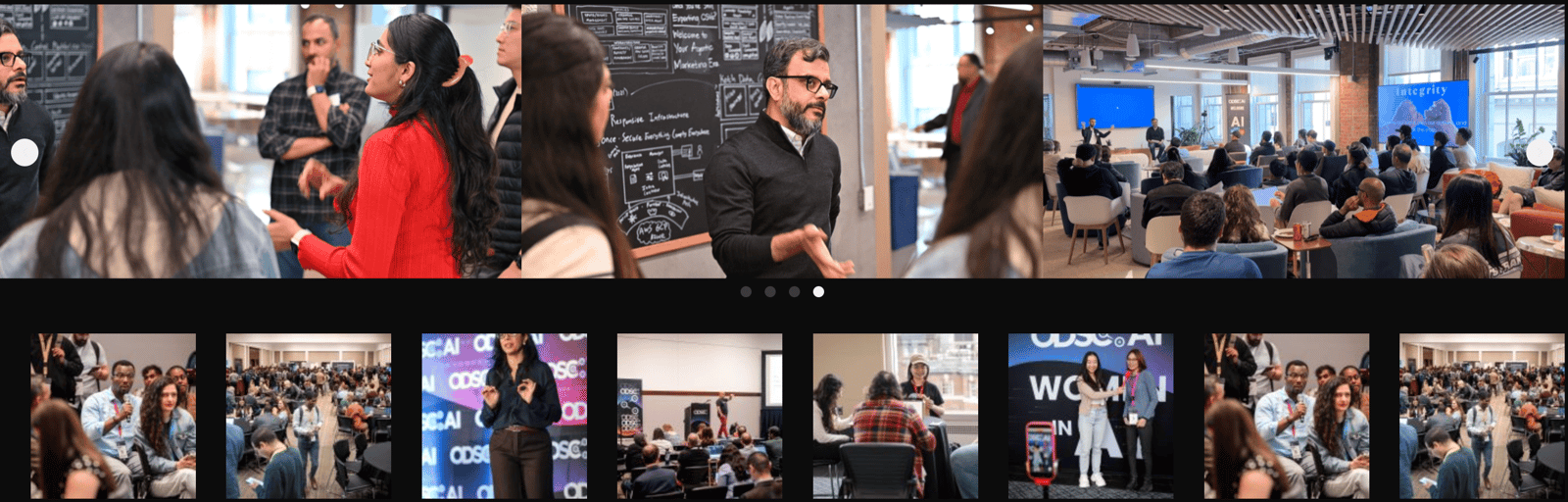
We're the ultimate builder-first community for data scientists, AI/data engineers, and developers. We’re moving past the pitch decks to bring the real meetup vibes back. This is all about raw live demos, discovering new tools, hacking with AI agents, and getting the inside scoop from the people who actually ship AI. Whether you’re here to watch an agentic workflow layout live, crack open some fresh open-source frameworks, or just here for the pizza, cold beers, and a genuinely good time with real humans, we’ve got your seat saved.
18/11/2026
Cormano - Hacklab Cormano: [PRESENZA] mini corso embedded e domotica III (atrent)
Hacklab Cormano
Milano - POuL: OpenMC Course 2026 - In-Depth Properties
The course will also be available via live stream (barring any technical issues!).
The link will be posted on our Telegram channela few minutes before the lecture begins.
Recordings and material will be available online, just like any other POuL course:
don't be afraid to miss out on a lesson, but attendance is suggested!The course will be held in the Bovisa La Masa campus.
You can also see reminders, checklists and commands you'd like to copy on this pad
https://pad.poul.org/s/P7qYFep6c4.The lectures do not expect you to follow along with your device, but you can
try experimenting by yourself while you listen to the explanation!This course begins with a quick theory section to bring everyone up to speed
on why someone would want to learn how to use this code.Everyone is welcome even beyond nuclear engineering students.
The first day focuses on the outmost basic structure and features of the code,
giving a good basic amount of knowledge to get a simulation to run.The second day delves deeper into each section of creating a model and configuring
our simulations, along with additional tips and advice on how to properly tidy upthe code.
Once you get a grasp on how the code works, the third day will focus on good
practices for a scientific computing environment, how to optimize the simulationand more advanced features, along with some interesting developements and
applications of this software.Luogo: Campus Leonardo - B12 L.01 - Milano
GRUSP - GRUSP: laravelday - Verona
GRUSP
19/11/2026
Milano - ODSC AI Milano: AI for Work: Build Your Own AI-Powered CRM
ODSC AI Milano
Pre-Registration is REQUIRED. Joining link -https://streamyard.com/watch/ZTUy3awMp3J8What would it take to build a CRM around the way your team actually works?
Join Sheamus McGovern, Founder of ODSC AI, for a practical walkthrough of an AI-powered CRM that brings together prospect sourcing, company research, qualification, personalized outreach, and follow-ups—with human approval at key stages.
WHEN
November 19 at 1:00 PM ET
Free live webinarWHO SHOULD JOIN?
If you already use AI for everyday tasks and want to explore building an application for your team, this session is for you.
It’s especially useful for:- Sales and business development professionals
- Marketing and operations teams
- Product and project managers
- Founders and small business teams
- Anyone interested in turning a recurring business process into an AI-powered application
WHAT YOU’LL LEARN
Using a working CRM, Sheamus will show you how to approach your own build:
- Map your workflow. Identify the steps, decisions, and information your application needs.
- Turn your team’s procedures into reusable AI skills. Give the system clear instructions for tasks you repeat.
- Build in manageable stages. Use an AI coding assistant to develop your application one part at a time.
- Connect your existing tools. Bring the application into the way your team already works.
- Test real scenarios and keep people involved. Add human approval where it matters and document how the system runs.
You’ll leave with a blueprint for your first version, an understanding of the tools involved, and a practical starting point for your own build.
The CRM is the example—the approach can help you tackle other recurring processes across your business, too.Useful Links
\\odsc.ai\\*
- Free access to more talks/trainings: Ai+ Training platform
- ODSC Blog: opendatascience.com
- Slack Channel: Join the Community
Venezia - PyVenice: PyVenice #8 a Vicenza !
PyVenice
Carissimi, continuiamo il nostro viaggio itinerante per il #Veneto a #Vicenza !Ci troviamo in #presenza giovedì 19 novembre alle ore 19:00.
La location sarà presso L'Elevator Innovation Hub di Vicenza. E per chi non potesse raggiungerci, si terrà anche in #streaming su YouTube.La scaletta prevede uno speech seguito da discussione. 🗣 Mattia Carolo ci racconterà come fare girare Qwen su vLLM e infrastruttura Google GKE, attraverso le cose che si sono rotte davvero e nessuno tutorial ti ha mai detto.
E dopo\, per chi vuole\, resteremo lì per \( 🍸 \| 🍺 \) e \( 🍕 \| 🍔 \)
e #networking ad oltranza ‼️📽 E se avete piacere di condividere idee, progetti, argomenti, o proporvi come prossimi speaker, lascio un form Google e la pagina Sessionize !
Torino - WordPress Torino: WordPress TO #113 WordPress e MCP: un caso studio
WordPress Meetup Torino
Quanti siti abbiamo lasciato fermi perché non c'era mai tempo? Progetti personali, siti di community, idee rimaste a metà. In questo talk Michele racconta come ha usato l'AI per rimettere in pista wptorino.it, e perché un sito inattivo è il posto ideale per sperimentare.Il talk esplorerà cosa sanno fare oggi gli agenti AI e come, grazie al protocollo MCP, possono lavorare direttamente dentro WordPress e nei page builder per poi analizzare il percorso reale del progetto: l'idea iniziale, le scelte fatte prima di scrivere un solo prompt, la costruzione con l'AI e la revisione finale.
A chi si rivolge: a chi crea siti per professione, a chi sviluppa e a tutte le persone appassionate di WordPress, anche senza esperienza con l'AI.
Interviene: Michele Cardinali, Michele Cardinali,
web designer e sviluppatore, specializzato in architettura dell’informazione, UX/UI e design system.After Meetup
Terminiamo il nostro incontro con chiacchiere e networking. Porta un cibo o una bevanda da condividere: sarà ancora più piacevole stare insieme.\\Partecipa. \\
Proponi un talk per il prossimo Meetup!Compila ed invia il modulo
https://www.wptorino.it/2017/02/05/proponi-un-talk/La chat ufficiale di WordPress in Italia è su Slack
https://it.wordpress.org/slack/ canale slack #wptorinoTwitter @wptorino
Email [[mailto:info@wptorino.it'>mailto:info@wptorino.it](http://mailto:info@wptorino.it'>info@wptorino.it](mailto:info@wptorino.it))Roma - Rome AI ML and CV: Nov 19 - Visualizing and Debugging Hugging Face's LeRobot Data
Rome AI, Machine Learning and Computer Vision Meetup
This workshop is a hands-on tour of what actually breaks when you load real LeRobot datasets, and how Voxel51's native LeRobot support in FiftyOne catches it.Date, Time and Location
Nov 19, 2026
9:00 AM - 10:00 AM PSTOnline. Register for the Zoom!
Robot learning data doesn't look like the data that trains most vision-language models. It's temporal, low-dimensional in the parts that matter most, embodiment-specific, and expensive to collect, and increasingly, it's shipped in Hugging Face's LeRobot format. But packaging robot data consistently isn't the same as being able to see it: episodes hide broken metadata, silently dropped sensor modalities, and mismatched schemas between robots that look identical on paper.
Starting from the core differences that make robot data hard (temporal structure, proprioception, action grounding, embodiment heterogeneity, data scarcity), we'll move into live debugging: a metadata bug that broke multiple dataset imports, sensor streams that vanish without an error, and two robots running an identical benchmark whose data is structurally incompatible. By the end, you'll know what to check before you trust a LeRobot dataset, and how to actually look inside one.
GRUSP - GRUSP: reactjsday - Verona
GRUSP
20/11/2026
Pordenone - PNLUG: preparazione stand linux arena 2
PNLUG
Milano - POuL: OpenMC Course 2026 - Advanced Setup and Options
The course will also be available via live stream (barring any technical issues!).
The link will be posted on our Telegram channela few minutes before the lecture begins.
Recordings and material will be available online, just like any other POuL course:
don't be afraid to miss out on a lesson, but attendance is suggested!The course will be held in the Bovisa La Masa campus.
You can also see reminders, checklists and commands you'd like to copy on this pad
https://pad.poul.org/s/P7qYFep6c4.The lectures do not expect you to follow along with your device, but you can
try experimenting by yourself while you listen to the explanation!This course begins with a quick theory section to bring everyone up to speed
on why someone would want to learn how to use this code.Everyone is welcome even beyond nuclear engineering students.
The first day focuses on the outmost basic structure and features of the code,
giving a good basic amount of knowledge to get a simulation to run.The second day delves deeper into each section of creating a model and configuring
our simulations, along with additional tips and advice on how to properly tidy upthe code.
Once you get a grasp on how the code works, the third day will focus on good
practices for a scientific computing environment, how to optimize the simulationand more advanced features, along with some interesting developements and
applications of this software.Luogo: Campus Leonardo - B12 L.01 - Milano
GRUSP - GRUSP: angularday - Verona
GRUSP
21/11/2026
Pordenone - PNLUG: linux arena 2
PNLUG
22/11/2026
Pordenone - PNLUG: linux arena 2
PNLUG
02/12/2026
Cormano - Hacklab Cormano: [ONLINE] farsi un server mail (domenico)
Hacklab Cormano
05/12/2026
Mantova - LUGMan: Un Pomeriggio Intelligente
Un pomeriggio a condividere conoscenze sulla Intelligenza Artificiale, insieme a esperti del settore.
Luogo: Creative LAB - Lunetta (MN) - Mantova
10/12/2026
Roma - Rome AI ML and CV: Dec 10 - AI, ML and Computer Vision Meetup
Rome AI, Machine Learning and Computer Vision Meetup
Join our virtual meetup to hear talks from experts on cutting-edge topics across AI, ML, and computer vision.Date, Time and Location
Dec 10, 2026
9:00 AM - 11:00 AM PSTOnline. Register for the Zoom!
Your mAP is fine. Your slices are not. Finding the images that actually matter
A single mAP can look acceptable while one slice is unusable, small objects, occlusion, or a confused class. I will run a pretrained detector on a few hundred public images (COCO-style, not a production crawl), report the headline metric, then break the same run by slice and walk through the worst samples.
The claim is modest: you do not need a million images or a trained-from-scratch model to see what the mean is hiding, and you cannot relabel everything, so the next labeling budget should follow those slices. No employer data and no confidential dashboards.
About the Speaker
Amandeep Jiddewar is a Machine Learning Engineer at Pinterest, with prior work in U.S. manufacturing analytics (CertainTeed / Saint-Gobain) and marketplace allocation (QuinStreet). Emory Goizueta MSBA (2019), Kaggle Expert. This talk is in his personal capacity and does not represent his current or prior employers.
Production AI Agents: Tool Use, Evaluation, Guardrails and Observability
Building an AI agent is easy. Knowing whether it is behaving reliably in production is much harder. This session explores how to evaluate agents that use tools and external systems, including tool-call validation, tracing, observability, failure analysis, guardrails, permissions, and human review.
Attendees will learn practical patterns for understanding not just what an agent answered, but why it acted and whether the action was safe.
About the Speaker
Akshay Talathi is a Vice President at Goldman Sachs with over 10 years of experience building large-scale, cloud-native, and distributed systems across financial services and technology. His current focus is GenAI and agentic AI, including production AI agents, MCP, enterprise integrations, guardrails, observability, and reliable AI-driven workflows.
From Virtual Worlds to Physical AI: Building Simulation Pipelines That Survive the Real World
Robots are moving beyond perception systems that only detect and classify objects toward systems that must understand a scene, learn behaviors, and act in the physical world. In this talk, I’ll show a practical Physical AI workflow using OpenUSD, BowerBot, NVIDIA Isaac Sim and Isaac Lab to build a robot’s virtual world, including its body, cameras, sensors, and environment.
We’ll explore how demonstrations and reinforcement learning can teach behaviors in simulation, how vision and sensor data become observations for a robot policy, and what needs to match when transferring that behavior to real hardware. The demo follows a small robot from a simulated environment toward a real-world task, exposing both the power and the limitations of sim-to-real.
The goal is to make the path from pixels to actions concrete for computer vision and machine learning practitioners.
About the Speaker
Arturo Morales Rangel is the founder of Binary Core LLC, a Physical AI engineering company working across simulation, perception, robot learning, and deployment.
Prompting Video-Language Models in Production: Lessons from Enterprise Video Tagging and Evaluation
Video-language models can now describe, tag and answer questions about long-form video, but production results depend heavily on prompt design and evaluation. This talk shares field lessons from deploying such models for media, news, streaming and sports organizations, including how to structure prompts for consistent, schema-bound outputs across hours of footage.
On one sports video-tagging project, consolidating the prompt definitions cut estimated processing cost about 3x, and about 90% of the originally reported issues were later resolved through prompting alone. I'll also walk through building evaluation frameworks for video outputs, including for hard domains like egocentric video, and what changes when migrating between model versions.
Attendees will leave with reusable prompt patterns and an evaluation checklist they can apply to their own video pipelines.
About the Speaker
Yash Gugale is a Senior Forward Deployed Engineer at TwelveLabs in New York, integrating video foundation models (Marengo for embeddings and search, Pegasus for video-language understanding) for media, news, streaming and sports customers. He previously spent about six years in video streaming engineering at Peloton and Samsung TV Plus, and holds an MS in Computer Graphics Technology from Purdue.
11/12/2026
GRUSP - GRUSP: BetterSoftware - Milano
GRUSP
17/12/2026
Venezia - PyData Venezia: PyDataVE #30
PyData Venice
Dear all, we’re back with the PyData meetups, focused as always on sharing best practice, methodologies, analysis, machine learning systems, .., with the open-source projects of the NumFOCUS program — but not only!We’ll meet #InPresence on Thursday, December 17 at 7:00 PM.
We’ll be hosted by Anda Venice Hostel in the Medusa Room and, for those who cannot join us, it will also be on YouTube in #streaming.👥 We’ll have two interesting sessions, in Italian 🇮🇹 or in English 🇬🇧 or one and one:
🗣 The agenda is still a work in progress.And afterwards\, for those who want\, we’ll stay there for \( 🍸 \| 🍺 \) & \( 🍕 \| 🍔 \) and #networking until late ‼️
📽 And if you’d like to share ideas, projects, topics, or propose yourself as the next speaker, here’s the usual Google form or Sessionize !
19/12/2026
Mantova - LUGMan: Apertura Sede
LUGMan
Elenco dei Calendari
- AVILUG -

- AperiTech Milano
- BgLUG Bergamo -
- Bologna JS
- Cassino LUG
- Coding Bunker
- ComaSCH
- Data Cloud AI Milano
- Data Science Milan
- Data Science Seed Genova
- Developers Italia -
- DevRomagna
- FLUG -
- Free Circle -
- GDG Cloud Milano
- GDG Pisa
- GOLEM -
- Google Developer Group Roma
- GRUSP -
- Hacklab Cormano -
- Hacklab Cosenza -
- ILS Alessandria -
- ILS Casorate Sempione -
- ILS Este -
- ILS Perugia -
- ILS Rieti -
- ILS San Dona' di Piave -
- ILS Torino -
- JUG Torino
- Kubernetes & Cloud-Native Milano
- LugAnegA -
- LUGCE -
- LUGMan -
- Lugotto -
- Milano Apache Kafka
- Milano Cybersecurity
- Mittelab -
- Mozilla Italia -
- NaLUG -
- Nix Milano
- ODSC AI Milano
- OpenSearch Project Rome
- OpenShift and Cloud Native Milan
- Open Source Saturday Milano
- PCOfficina -
- PLUG -
- PNLUG -
- POuL -
- PUG Bologna
- Pug Milano
- PUG Modena
- PUG Roma
- PUG Romagna
- PUG Seregno
- PUG Sondrio
- PUG Torino
- PyData Milano
- PyData Roma Capitale
- PyData Venezia
- Python Bari
- Python Catania
- Python Milano
- Python Pescara
- Python Torino
- PyVenice
- R-Ladies Rome
- Roma Apache Spark
- RomaJS
- Rome AI ML and CV
- Rome MongoDB
- Rome R Users Group
- Rust Milano
- SFSCon -
- Torino JS
- VeLug
- Woocommerce Torino
- WordPress Catania
- WordPress Genova
- WordPress Lecce
- WordPress Milano
- WordPress Padova
- WordPress Roma
- WordPress Terni -
- WordPress Torino -
- WordPress Verona
Calendari
Questa pagina aggrega automaticamente contenuti fino ai prossimi 2 mesi provenienti da calendari iCal, CalDAV o Meetup.com.
Per aggiungersi
Per essere inseriti le comunità devono rientrare nelle libertà digitali con un interesse al mondo Open Source.Un calendario Google pubblico ha la versione ICS come anche i gruppi Mobilizon.
Le segnalazioni manuali di eventi non sono gestite.
Il codice di questo sito si trova su GitLab con tutti i calendari.

